
How Bench Warrants Work in Sioux County
Think of a bench warrant as a judge's way of enforcing something a case already required. In Sioux County the common triggers line up with what you'd expect: failure to appear, unpaid fines or costs, contempt, probation violations, and other missed obligations. Not every slip produces a warrant, though. The judge decides. On the court side, the Iowa District Court for Sioux County is the public route, with judicial magistrates and district associate judges working inside Iowa's unified trial-court system. Cities here also enforce their own ordinances, and city police can serve warrants, but there is no separate public municipal bench-warrant database to check. A city case question usually loops back to Iowa Courts Online and the Sioux County Clerk of Court, where the docket lives.
Missed Court in Sioux County
After a missed date, run the name, case number, or citation number through Iowa Courts Online and open the chronological summary for any failure-to-appear entry, hearing, order, or money item. That docket is not the official court record. Call the Sioux County Clerk of Court at 712-737-2286 or CountyClerk.Sioux@iowacourts.gov and ask what the judge wants: a reset hearing, a written motion, a payment plan, or a personal or attorney-arranged appearance. Don't guess from a docket label.
Call before appearing: A confirmed bench warrant can lead to custody, and Sioux County publishes no guaranteed walk-in recall or safe-surrender window.
Bench Warrant Issuance in Sioux County
Issuance starts in the existing case, where a judge or magistrate reviews the missed duty or the alleged noncompliance and can sign an order authorizing arrest. The clerk keeps the court record after that. The sheriff may receive it, publish it, serve it, or hold the law-enforcement copy, and city police can help inside their own jurisdictions. Between agencies, warrant information moves through the restricted IOWA System, which Iowa DPS does not open to citizen searches. Iowa Code section 804.4 lets a warrant be delivered to a peace officer and executed anywhere in Iowa, so a Sioux County bench warrant is not limited to contact inside the county. It also stays open until the court acts, by recalling it or by service that sends the case forward. A stale public PDF can lag behind a court order. When status changes, confirm it with both the court and the sheriff.
Sioux County Contempt and Court Debt
The sheriff's roster mixes charge text with reason text. Sioux County entries observed there include contempt and failure to pay a fine or cost, often sitting right beside a bench or failure-to-appear record. Court debt and a warrant are not the same thing, so read the label carefully.
- Failure to appear
- A missed required court event.
- Contempt
- Failure to obey a court order, subject to a judge's finding.
- Recall
- The court withdraws an issued warrant.
- Quash
- The court sets aside legal process through an order.
- Bond
- Security for release and future appearance, not dismissal.
Eligible court debt can go through the official Iowa ePayment system. Paying the balance, though, does not by itself establish that a Sioux County bench warrant was recalled. Ask the clerk what order must be entered and how to get proof.
How Bench and Arrest Warrants Differ
Both kinds end in custody, but they start differently. A bench warrant enforces a duty inside a case already open in Sioux County. An arrest warrant begins with a complaint or citation plus a judge's finding that an offense is supported.
| Feature | Bench Warrant | Arrest Warrant |
|---|---|---|
| Trigger | Missed court, contempt, or noncompliance | Probable cause of an offense |
| Case posture | Usually an existing case | May begin the arrest process |
| Issuing authority | Judge or magistrate in the case | Judge or magistrate after complaint review |
| Next step | Recall, hearing, compliance, or service | Arrest, initial appearance, and release review |
| Who confirms | Issuing court and holding agency | Issuing court and serving agency |
A court-debt entry can ride along with either one. Bond shapes release in Sioux County, yet it does not dismiss the charge or erase the duty to appear.
Sioux County Sheriff and Clerk Roles
The sheriff's dated warrant PDF is a good place to spot a possible record, listing warrant number, issue date, type, charge, bond, and disposition fields. It has no public code key, and it cannot tell you what the judge requires now. For current law-enforcement status, service questions, or booking guidance, call sheriff administration at 712-737-2280 or jail staff at 712-737-3131. The Public Safety Center sits at 4363 Ironwood Ave Ste 1 in Orange City, and the jail runs around the clock, though that does not make every hour a public surrender or warrant-resolution window. The official Sioux County court contact page carries the court's own contact details with no case data.
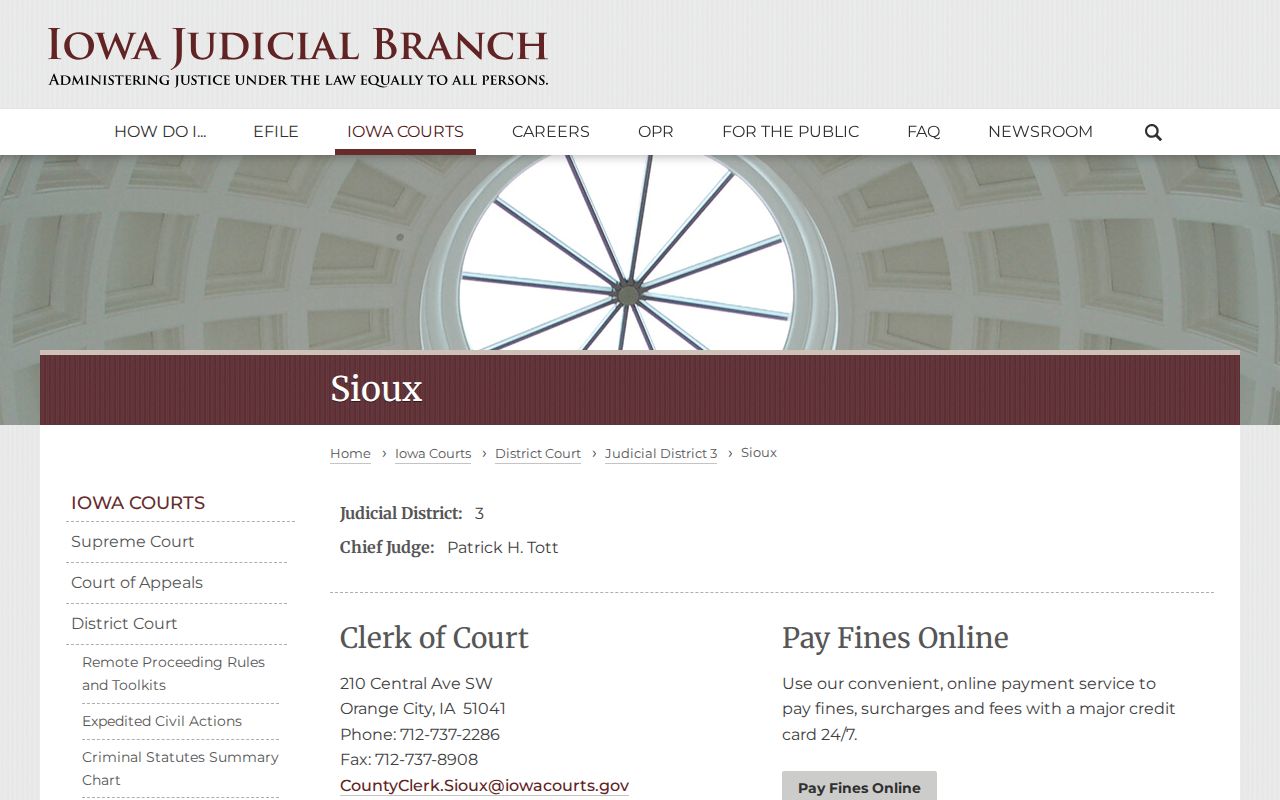
The clerk at 210 Central Ave SW in Orange City controls the District Court file and routes the judge's process. Case scheduling runs through 712-279-6608 extension 39749. In Sioux County, one office confirms custody and service, the other confirms docket and recall. Use both.
Clearing a Bench Warrant in Sioux County
Resolution starts with the case, not a payment promise or a trip to the jail. What the court requires depends on the missed event, the charge, past orders, and release conditions. Sioux County publishes no single recall form or standing walk-in docket for all bench warrants.
- Find the warrant number and underlying case through the official list and docket.
- Call the Sioux County Clerk before appearing and ask what the judge requires.
- Consult an attorney about a motion, hearing, or arranged appearance when appropriate.
- If surrender is required, ask the sheriff where and when booking occurs.
- Ask about bond and release without treating a schedule as a guarantee.
- Complete the ordered hearing, payment, or compliance step.
- Obtain court confirmation of recall and ask when the sheriff list will update.
The Iowa uniform bond schedule sets starting amounts for some offenses when courts are closed, subject to exclusions and judicial change. A roster figure is only a clue. The Sioux County judge may set different terms.
Confirm Sioux County Recall Updates
Timing is the trap in Sioux County. A judge's recall order and the public list rarely move together. Once the bench warrant is recalled, ask the clerk of court for a copy of the order or some other written confirmation. Then ask the sheriff's office when its public warrant list and internal status will catch up. Recall is not the end of the case either. A person may still owe a hearing, payments under a plan, probation terms, or a defense against the charge, and skipping the next event invites more enforcement. Keep every date, contact name, and court record in one safe place. Note: a row that disappears after an update is a reason to follow up, but only the Sioux County court can confirm a recall.
Sioux County Courts That Issue Bench Warrants
Sioux County sits in Iowa Judicial District 3. Its District Court takes criminal, traffic, juvenile, family, and civil matters. Magistrates and district associate judges approve complaints, issue warrants, hold initial appearances, and handle whatever else the law assigns them. Appellate courts do not serve as the local warrant counter.
| Source | Role | Public route |
|---|---|---|
| District Court or magistrate | FTA, contempt, order enforcement, bond | Iowa Courts Online and clerk |
| Traffic docket | Citation, missed date, debt, appearance | Docket, pay-fine route, clerk |
| Juvenile Court | Youth matters with access limits | Clerk subject to section 232.147 |
| Sheriff | Publishes, receives, serves, and holds | PDF, phone, narrow records request |
| City police | Local service and referral | Police contact; no city database found |
Where an officer stops you matters less than where the case was filed. Trace the issuing court first with a Sioux County warrant check, then pursue the recall there.
Special Sioux County Access Limits
Juvenile and family files get tighter handling than the ordinary public criminal docket in Sioux County. Iowa Code section 232.147 governs juvenile court and social records, so a missing youth-related record proves nothing about whether a court order exists. Iowa Code Chapter 22 builds the public-record framework while shielding confidential categories. The sheriff may redact birth dates, driver-license details, active-investigation records, witness and victim data, and health information. No personal request, however narrow, overrides those limits. Watch for scam calls too. A caller claiming a missed date produced a bench warrant and demanding gift cards, cryptocurrency, or cash is a fraud signal. Iowa Judicial Branch warnings state that court fees go through the clerk, secure Iowa ePayment, or the official court-debt line. Verify with contact details you look up yourself, never a number the caller supplies.